


Strong Nano-Architected Materials
by Residual Stress Engineering
SuNRISE — Strong Nano-Architected Materials by Residual Stress Engineering is a research project funded under the Italian FIS programme and hosted at Roma Tre University. The project addresses a central limitation of nano-architected materials: the lack of mechanical reliability despite outstanding strength-to-density ratios.
SuNRISE treats residual stress and interfaces as design parameters rather than secondary effects, enabling the development of nano-architected systems with controlled failure behaviour and reproducible performance.
Scientific Motivation
Nano-architected and metamaterial systems produced by advanced manufacturing techniques can achieve exceptional mechanical properties. However, their practical deployment is often limited by:
- strong sensitivity to defects and processing variability
- uncontrolled residual stress build-up during fabrication and coating
- poor understanding of crack initiation and propagation mechanisms at small scales
As a result, strength gains do not necessarily translate into reliable, predictable performance.
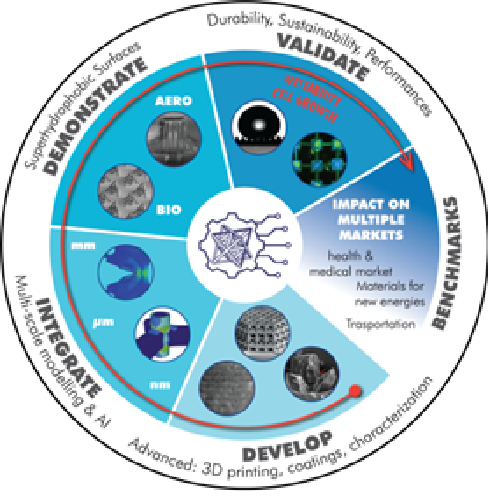
SuNRISE directly addresses this gap by integrating fabrication, coating, characterisation, modelling, and data-driven analysis into a unified, stress-aware design framework.
Core Scientific Hypothesis
The mechanical response and failure of nano-architected materials are interface- and surface-dominated phenomena.
By coupling:
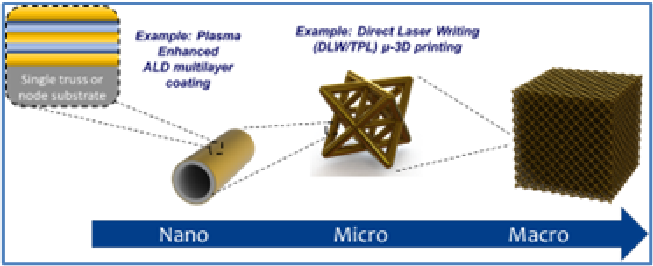
- architectural design (via Two-Photon Lithography),
- conformal nano-coatings with tailored stress states (via (PE-)ALD and PVD),
- high-resolution mechanical and stress characterisation, and
- predictive structural modelling and machine learning
Residual stress distributions can be engineered to delay crack initiation, steer crack paths, and improve reliability, rather than simply maximising peak strength.
Research Objectives
SuNRISE pursues four tightly connected objectives:
O1
Architecture and Processing
Develop reproducible nano-architected structures using Two-Photon Lithography, including polymeric and ceramic-derived systems, with geometry explicitly designed for stress control.
O2
Stress-Engineered Interfaces
Design and deposit conformal multilayer nano-coatings with controlled residual stress gradients and interface quality on complex 3D architectures.
O3
Characterisation and Modelling
Quantify residual stress, fracture, and crack propagation using advanced small-scale mechanical testing and structural modelling, linking local stress states to global failure behaviour.
O4
Predictive and Data-Driven Design
Integrate modelling and machine-learning tools to transform experimental data into predictive design rules for reliable nano-architected materials.
Methodological Approach
SuNRISE follows a closed-loop research strategy

TPP-DLW 3D Printing
Fabrication of nano-architected structures (TPL, pyrolysis where applicable)

ALD/PVD Coating
Surface and interface engineering via conformal nano-coatings

Characterization
High-resolution characterisation of residual stress and mechanical response
Modelling
Structural modelling of stress, fracture, and failure mechanisms
Optimization
Data-driven optimisation to refine architectures and processing routes